City guide

    Phu Quy

    Phu Quy

    About Phu Quy

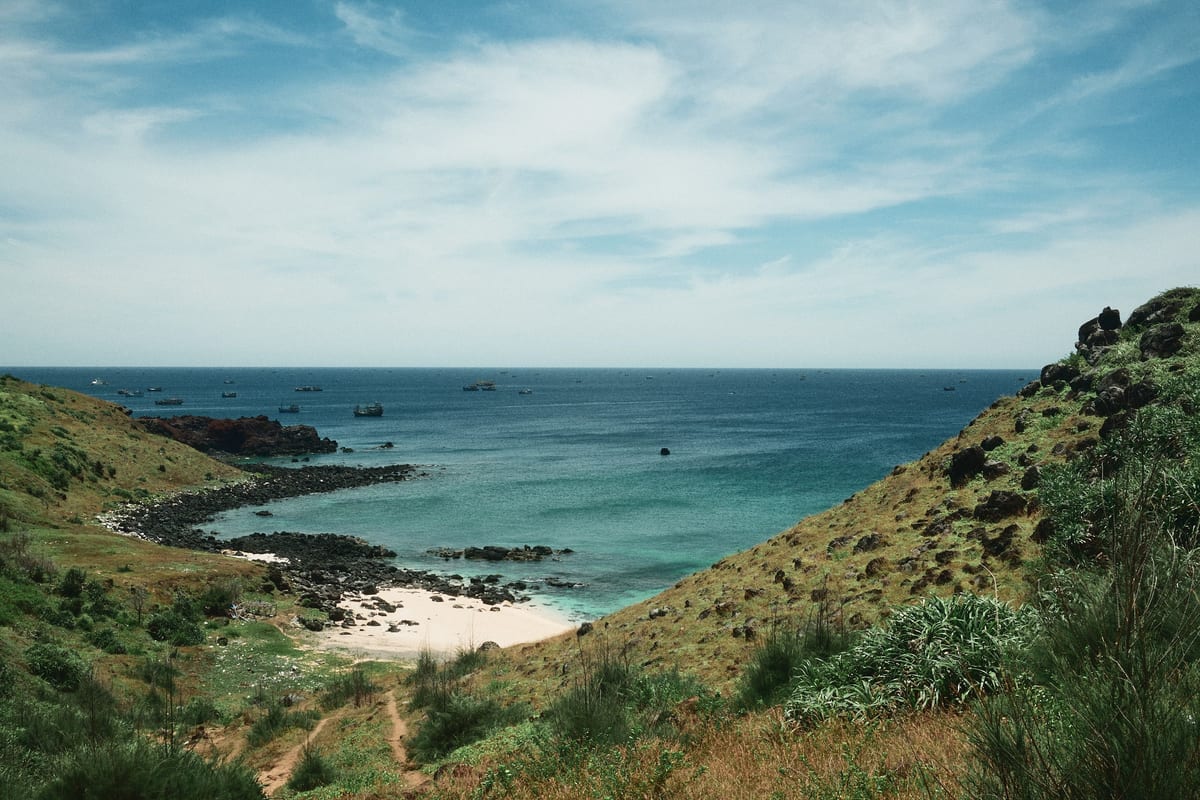
    A remote volcanic island known for clear water, rugged coastlines, fishing villages, and a laid-back local pace.

    At a glance

    Country
    Vietnam
    Region
    South Central Coast Vietnam
    Recommended stay
    2-4 days
    Daily cost
    ≈ $35 / day
    Best time to visit
    Dec –⁠ Apr

    Before you go to Phu Quy

    When to go

    Climate through the year

    Scroll to see all months

    Monthly rainfall and temperature
    MonthRainfall (mm)Temperature (°C)
    January2024–29
    February1024–29
    March1025–30
    April3026–31
    May12027–32
    June18027–32
    July22027–32
    August25027–32
    September22026–31
    October12026–31
    November5025–30
    December2024–29

    Dry season (Dec–⁠Jun)

    Best overall time for Phu Quy: sunnier skies, calmer seas, and better ferry conditions. Vietnam Tourism notes the island’s dry season runs from December to June, with the clearest weather generally in the first half of the year.

    Best for beach time, snorkeling, motorbike loops, and easier island transfers.
    Can still be windy and hot; accommodation and ferry demand can rise around holidays and weekends.

    Ideal for: Beaches, coastal viewpoints, lighthouse visits, and relaxed island exploring.

    Pack: Light clothing, sun protection, sandals, and a windbreaker for ferry rides.

    Rainy / rough-sea season (Jul–⁠Sep)

    Less reliable weather, with stronger winds and rougher seas; Vietnam Tourism specifically recommends avoiding the rainy season for Phu Quy.

    Fewer visitors and potentially lower prices on some stays.
    Ferry disruptions, choppier water, and reduced beach comfort.

    Ideal for: Flexible travelers who can change plans at short notice.

    Pack: Rain jacket, motion-sickness tablets, waterproof bag, and extra buffer days.

    Shoulder months (Oct–⁠Nov)

    Transition period after the rainy season; often a practical time to visit as conditions improve toward the dry season.

    Better value than peak dry-season dates, with improving weather.
    Weather can still be variable early in the season.

    Ideal for: Budget-conscious solo travelers who want a quieter island.

    Pack: Light layers, sun protection, and a compact rain shell.

    Peak dry months (Jan–⁠Apr)

    Usually the most comfortable stretch for island travel, with warm, dry conditions and good visibility.

    Best balance of weather, sea conditions, and outdoor activities.
    More demand for ferries and rooms, especially around Tet.

    Ideal for: First-time visitors, beach days, and photography.

    Pack: Breathable clothes, hat, sunscreen, and sturdy sandals.

    Daily budget

    Low season / day
    $25 –⁠ $45 (rainy/shoulder season, excluding accommodation)
    Peak season / day
    $35 –⁠ $70 (dry season, excluding accommodation)
    Cash
    Carry 500,000 –⁠ 1,000,000 ₫ in small bills for ferries, local food, and small shops.
    Exchange
    Use banks or licensed exchange counters in mainland cities before heading to the island; avoid informal money changers.
    ATMs
    Limited compared with big cities, so withdraw enough cash before departure and keep a backup card.
    Cards
    Low to moderate - cards may work at some hotels and larger restaurants, but cash is still the norm for ferries, street food, and small businesses.

    Events & festivals

    • Tet (Vietnamese Lunar New Year)

      Late Jan or Feb (varies by lunar calendar)

      Family reunions, temple visits, festive food, and holiday decorations across Vietnam.

      Tip: Book ferries and accommodation early; many businesses may close or run reduced hours during the holiday.

    • Mid-Autumn Festival

      Sep or Oct (15th day of the 8th lunar month)

      Lanterns, mooncakes, children’s processions, and a lively evening atmosphere in Vietnamese towns and cities.

      Tip: Best experienced in larger mainland towns before or after your island leg, since Phu Quy is quieter and more low-key.

    Getting there

    How to reach Phu Quy from abroad or within Vietnam.

    Arriving internationally

    • Phu Quy is an island in Binh Thuan Province, Vietnam, and there is no airport on the island; international travelers must first fly into Vietnam, then continue overland to Phan Thiet before taking a ferry or high-speed boat to Phu Quy.
    • The usual gateway is Tan Son Nhat International Airport (Ho Chi Minh City) or other major Vietnamese airports, followed by a bus, train, or private transfer to Phan Thiet. Vietnam Tourism notes that Phu Quy is reached via Phan Thiet City first.
    • From Phan Thiet, take the Phu Quy Express or another high-speed passenger boat service to the island; the operator publishes route schedules and ticketing information on its official site.

    From within the country

    • From Ho Chi Minh City, the most practical route is bus or train to Phan Thiet, then ferry/high-speed boat to Phu Quy. Vietnam Tourism describes Phan Thiet as the mainland access point for the island.
    • Within Vietnam, buses and trains are the main budget-friendly ways to reach Phan Thiet; ride-hailing and taxis are useful for the final transfer to the port.
    • On the island itself, Vietnam Tourism says you can rent a bicycle or motorbike, or arrange a taxi through your accommodation host.

    Booking & arrival tips

    • Book the boat ticket early, especially on weekends and holidays, because Phu Quy is a small-island route with limited capacity.
    • Check sea conditions before departure and keep one buffer day in your itinerary in case sailings are delayed or canceled. This is a practical inference from the island ferry setup and is especially important for solo travelers.
    • For the cheapest island transport, rent a motorbike or bicycle after arrival; for the easiest option with luggage, ask your homestay to arrange a taxi.
    • Carry some cash in Vietnamese dong because small-island transport and local services may not always accept cards. This is a practical travel inference for Phu Quy’s island setting.

    Getting around

    Motorbike rental

    Best for solo travelers who want flexibility around the island. About 120,000 –⁠ 200,000 ₫ / day.

    Bicycle rental

    Cheap option for short scenic rides in calmer areas. About 30,000 –⁠ 50,000 ₫ / day.

    Local taxi

    Good for luggage, airport-style convenience does not apply here; ask your accommodation to arrange one. Varies by distance.

    Boat transfer from Phan Thiet

    Main access link to the island; book in advance. Ticket price varies by operator and season.

    Good to know. Phu Quy is small enough that a rented motorbike is usually the most efficient solo-travel option; if you are not comfortable riding, use a taxi arranged by your host and avoid night riding on unfamiliar roads.

    Handy apps

    Google Maps

    Navigation and route planning.

    Download offline maps before leaving the mainland because island coverage and data speeds can be inconsistent.

    Grab

    Ride-hailing and food delivery in mainland Vietnam.

    Useful in Ho Chi Minh City or Phan Thiet before you board the boat; not the main transport app on Phu Quy itself.

    Green SM

    Electric taxi/ride-hailing in mainland Vietnam.

    Good backup for airport or city transfers before heading to Phan Thiet.

    be

    Ride-hailing and delivery in mainland Vietnam.

    Often useful for comparing fares with Grab before the mainland leg of your trip.

    BusMap / GoMo by BusMap

    Public transport planning in Vietnamese cities.

    Helpful for the mainland bus portion of the trip, especially around Ho Chi Minh City or Phan Thiet.

    Phu Quy Express

    Boat schedule and ticket information for the Phan Thiet-Phu Quy route.

    Check the official schedule before you travel and screenshot your booking details.

    Backup. Ask your homestay for a paper map, port directions, and a local driver contact in case your phone battery dies or mobile data is weak.

    Where to stay

    Nightly rates: $20 –⁠ $60 / night for homestays and simple hotels; higher for beachfront or premium stays

    Tam Thanh Commune

    First-time visitorsBudget travelersConvenience seekers

    Central commune on Phu Quy Island with the most practical access to the port, local eateries, and island transport. Best base for first-time visitors who want easy scooter or taxi access around the island.

    Ngũ Phụng Commune

    SightseeingSolo travelersLocal experience

    Administrative and service hub of Phu Quy, close to the lighthouse route and several local guesthouses. Good for travelers who want a balance of convenience, local life, and island sightseeing access.

    Long Hải Commune

    RelaxationCouplesQuiet stays

    Quieter coastal area with a more relaxed village feel and access to beaches and fishing life. Better for travelers who prefer a slower pace and lower-key stays.

    Phu Quy Port Area

    Transit travelersShort staysBudget travelers

    Best for short stays, early arrivals, and travelers who want to minimize transfer time after the ferry. Expect simple homestays and practical services rather than resort-style options.

    Phu Quy Lighthouse / Cam Mountain Area

    Nature loversPhotographersSlow travel

    Scenic inland-high point area with island views and easy access to one of the main landmarks. Stay here if you want sunrise, photography, and a quieter atmosphere, but note transport is more limited.

    Booking tip: Book early for weekends, holidays, and the dry season; solo travelers usually get the best value from homestays near the port or Tam Thanh.

    Health & safety

    Medical facilities

    • Trung tâm Y tế Phú Quý
      115

      Đặc khu Phú Quý, tỉnh An Giang, Vietnam

      Main local medical center on the island; use for urgent care and stabilization before transfer if needed.

    • Phòng khám Khu vực An Thới
      N/A

      Phú Quốc, Vietnam

      Not in Phú Quý; do not use for Phú Quý travel planning.

    • Bệnh viện Đa khoa huyện Phú Quý
      N/A

      Đặc khu Phú Quý, tỉnh An Giang, Vietnam

      Local district hospital listing for Phú Quý; confirm current contact through your hotel or local authorities before travel.

    Staying safe

    General safety
    Watch for petty theft around ferry terminals, beaches, and busy markets. Use licensed transport, keep valuables zipped and close, and avoid isolated roads or beaches at night.
    Notes
    Avoid tap water; use sealed bottled water or boiled water. Be extra careful on motorbikes and when crossing roads, and expect limited services after dark on an island setting.
    What to carry
    Comfy shoes, water bottle, basic meds (painkillers, antidiarrheal, mosquito repellent), sunscreen, hat, and a small flashlight/power bank for ferry delays or evening travel.
    Lost items
    Nearest local police station / district police on Phú Quý
    • Carry hand sanitizer for street food and shared surfaces.
    • Use sunscreen and a hat; heat and UV can be strong on the island.
    • Rest immediately if you feel dizzy, overheated, or seasick; dehydration can happen fast.
    • Use mosquito repellent and long sleeves at dusk to reduce bite risk.
    • Carry your insurance card and passport copy for faster service.
    • Call ahead or ask your hotel/local host to contact the clinic first in an emergency.
    • For serious cases, expect evacuation to the mainland; keep emergency cash and travel insurance details accessible.
    • If you lose a passport or valuables, report it to local police as soon as possible and keep a copy of the report for insurance and replacement documents.
    • For major accidents, storms, or evacuations, call 112 or local emergency services immediately.
    • Keep ferry tickets, accommodation address, and a charged phone with you in case you need help returning to your lodging.

    Local customs

    Etiquette & local habits

    • Dress modestly when visiting pagodas, temples, and local family-run places; cover shoulders and knees.
    • Use a calm, steady tone with locals; polite greetings and patience go a long way on a small island.
    • Bargaining is acceptable at informal markets, but keep it friendly and avoid haggling hard over small amounts.
    • Scooters are the main way to get around; if crossing roads, move predictably and do not make sudden stops.
    • Bring cash, as smaller guesthouses and eateries may not accept cards or may have limited payment options.

    When the city is open

    Many attractions and local services wind down around 5–⁠6 PM; seafood spots and casual nightlife can stay open later, but the island is generally quiet after dark.